Excerpt from A Tale Told by an Idiot: Full of Sound and Fury, Signifying Nothing — a memoir in progress
Chapter 10 — Schadenfreude
It was just another day at the office — sitting around with a group of guys swapping stories. Times gone past, hitting strangers over the head with pool cues, holding up a service station with a sawn-off double-barrel shotgun, stabbing people who “deserved it,” and various other impulsive acts of violence committed against whoever happened to be standing in the wrong place at the wrong time.
Normally, back then, a group of blokes reminiscing would be huddled around a campfire or down at the pub, beers in hand. These days, at the local cafe, sipping on a soy latte while wearing light-coloured chinos and shoes without socks, or even better — or worse, depending on your preference — a Lycra outfit with sponsor logos that weirdly don’t sponsor them, shaved legs, bicycle parked close by.
But not this lot.
This was deep inside the walls of a maximum-security prison, during a victim empathy session that I was a part of. The goal? To discuss their crimes and consider the impact of their actions on the people they’d hurt. A noble goal, sure. But it felt more like trying to teach a goldfish to play chess.
As each prisoner shared the gritty details of their crimes and attempted to squeeze out something resembling empathy, it was like watching someone try to pass a kidney stone. Their facial expressions said it all. You’d ask how their victims might have felt, and in return you’d get a puzzled expression and the thousand-yard stare of someone who’s just been asked to explain quantum mechanics while drunk.
Their faces would then go blank, expressionless. Botox-level blank. Come to think of it, I’ve never actually seen Botox done right. Is there such a thing as “just enough Botox”? Probably not. But I digress.
That day, though I didn’t know it at the time, I met what I went on to later refer to as the unapologetic. The people who could describe horror in perfect detail and feel nothing. I thought they were rare at the time. I thought they only lived behind bars. Turns out, they’re everywhere. Harder to spot, as they don’t all wear prison outfits. Some wear suits.
I first did time in prison back in the late ’90s. But it was during that empathy session with violent offenders that a few uncomfortable truths took root — truths that would stick with me for years and eventually help me understand who you should and shouldn’t let onto your boat. When I say eventually, I mean many, many years. When I say boat, yes, it’s a metaphor, but I learnt this while living on a boat, literally.
Eighteen years on, I found myself back in prison. I was sitting with Michael — a senior operations manager — one rung below the big boss.
Now, when you hear “senior manager,” you might imagine corner offices, ergonomic chairs, skyline views, and an assistant who exists solely to screen calls and fetch oat-milk lattes. Not here.
Michael’s office looked like a poorly furnished room in a trailer park. More like a shipping container dumped on a construction site. And yet here he was, responsible for the safety of an entire community. His portfolio? A maximum-security prison.
I’d worked in places where executives presided over meditation rooms, glass pods, and beanbags, with harbour views to soothe their tortured souls. Their portfolios? Toothpaste sales. A mining company’s “wellness” project. A health fund’s marketing team. Life-or-death stuff.
Meanwhile, Michael’s desk was propped up by Blu Tack and quiet resilience, keeping actual criminals from starting a riot, or scaling a wall, or attempting to escape via the dumpster on rubbish collection day, only to end up wandering into your neighbourhood.
He ran the corrections side — officers, inmates, lockdowns, and cavity searches. I ran the health service — doctors, nurses, dentists, physios, and the kind of mental health services that could scare the paint off a wall. The sort where you needed a sense of dark humour just to survive, like the inmates who did party tricks involving their bowels, purely to score a mini break in the city hospital. Believe me, it was never dull.
Strangely, the inmates were often the easiest part. Prisoners were prisoners. When I say easy, I’m not talking ‘being at ease sharing your personal details’ easy, but for the most part, predictable easy. Staff, however, were colourful. Not in a rainbow-flag kind of way. More like the kind of colour you find in a bruise.
Yep, eighteen years later, there I was — back in prison. Working.
Now, people tend to assume we’re talking men’s prisons. Wrong. I had carriage of both, and whenever I mentioned the women’s facilities to people within the trade, they’d pause, tilt their head, and say the same thing: “Good luck with that.”
Not just because of the inmates, but because of the staff drawn to work there.
The General Manager of the women’s prison once pointed out that men’s prisons rarely get offers from community groups to volunteer to help with inmates. The women’s prison, however, was flooded with offers of support. Let’s just say the general community views female and male prisons a little differently. Okay — let’s say a lot differently.
I should, however, make it explicitly clear that the women’s prison was for women only, unless, of course, you were a man with a penis who preferred to be in a women’s prison. Understandable, I suppose — the women’s prison was less like a prison, more like a rundown resort, with a playground for the inmates’ children, a swimming pool (known as the syphilis pool), landscaped gardens, and free hormone treatment to prevent erections in the female prisoners so the biological women don’t get pregnant, and of course, free weight-loss tablets. Makes sense, right? It didn’t for me when I first started, but it was made explicitly clear that it’s very logical. If I didn’t see the logic, I suspect I’d get a letter from HR.
Anyway, back in Michael’s office. As we chatted about life on the inside, my eyes landed on a photo of an army tank in the desert, soldiers kicking up dust. It was hung on the wall, in a cheap frame, that matched the decor.
“What’s that about?” I asked.
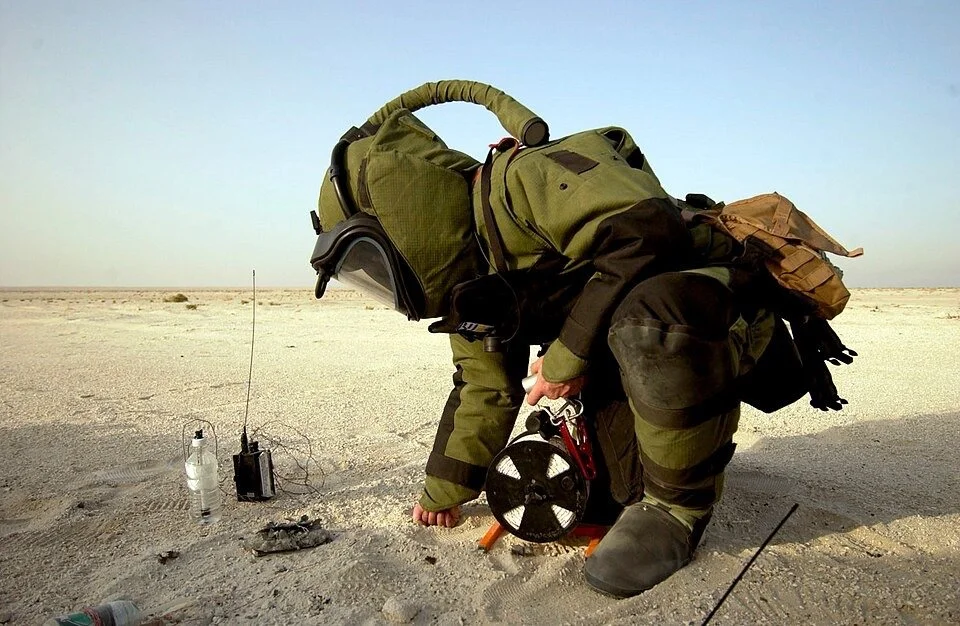
“That’s me,” he said casually. “Afghanistan. British Army. I used to disarm bombs.”
That caught me off guard. He didn’t look the part. No buzzcut, no glass-shattering stare. He was warm, thoughtful. Soft, but not in the Instagram-yoga way. Solid soft. The kind of person you’d trust in a crisis, or to hold your baby.
Of course he disarmed bombs. Everyone in this job had a backstory that made you question the selection criteria.
After a while, he added something quietly, almost as an afterthought. Before you could get near an IED (the short version of improvised explosive device) in Afghanistan, you often had to clear the site of casualties first. Bodies that had been lying in the open for days, sometimes weeks, in forty-degree heat. It wasn’t accidental. The Taliban knew exactly what they were doing.
Michael went on to say they would place IUDs beneath or beside the dead, deliberately. Knowing that soldiers would come. Knowing that no one leaves their own behind. The body was the bait. The despair and grief were the trigger mechanism.
The approach was straightforward, if you could call anything about it straightforward: the soldiers would tie a rope around the ankles of the body and drag them clear before you could begin to disarm the bomb. You didn’t kneel beside them. You tied the rope and you pulled from a distance.
Except the heat does things to a body. Decomposition in that climate is rapid and complete. And sometimes, when you pulled, the legs came away. Clean from the hip. Or the knee.
The only way I could relate was the woman’s leg I once carried after a train separated it from the rest of her body. I didn’t, however, have to contend with a bomb. The soldiers would adapt. Because the device still needed clearing. Because that was their job.
He described it the way you’d describe the steps for changing a car tyre. A logistical inconvenience. Something you encountered, solved, and moved past. I sat with that for a moment.
After a jaw-dropping conversation about life in Afghanistan, we drifted back to the workplace. Not the one in Kabul — the one in the prison.
“How’s the job?” I asked. “More specifically, how’s managing the staff?”
He let out a long sigh — the kind that comes from someone who’s seen too much. “Honestly? It’s hard. You try pulling someone up on performance and next minute you’re the subject of a bullying complaint. It’s impossible. I spend more time responding to bullying allegations than actually doing my job.”
I nodded. He wasn’t alone. I sensed something had shifted around 2010. By the time COVID rolled in, managing problematic staff had become a career-ending sport. HR departments had turned into Instagram therapists: “If someone feels hurt, then it must be bullying.”
Managers lost the ability to manage. HR went from being advisors to thinking they were managers — except they’d never actually managed anything. The good news was, we got to blame COVID for our social dysfunction. Just as the sailors years back blamed the bananas when things went wrong at sea. Truth was now negotiable. Intent didn’t matter. Performance management had become an interpretive dance of feelings.
When I coached managers, I gave them two pieces of advice:
Always bring a witness. Preferably one who won’t cry.
Be prepared to redirect the conversation twenty-three times back on topic, because those who need performance conversations are master illusionists. They’ll have you apologising for their behaviour before your coffee goes cold.
So, I asked Michael the obvious question: Where did you feel safer — managing staff here, or disarming bombs back in Afghanistan?
He leaned back, and without hesitation he said, “Honestly? Afghanistan. I felt safer. At least there I felt in control.”
He said it without flinching. No irony. No joke. Just fact.
And that was the moment I realised we are living in strange times. The man who literally defused live explosives in a war zone would rather go back to Kabul than manage Karen from Accounts.
That line hung in the air like a slow leak of gas.
And that’s when it hit me: what made talking to people more dangerous than disarming a bomb in Afghanistan wasn’t the subject matter itself. It was the loss of the ability to have conversations and debate — to work through the topic — rather than turning the conversation itself into a weapon of mass destruction.
A bit ironic, I know. Here we were dealing with the worst of the worst in society. Supposedly. Just remember, not everyone gets caught. And people in prison are the ones who commit overt crimes, not the covert ones.
When I say overt, I’m referring to those prisoners who come to the health centre escorted by the special operations group, handcuffed and chained, their movement restricted to the speed of regret. And despite the restraints, some still manage to get both hands around the head of a nurse, strangle them, and smash their head against a wall, or dislocate the shoulder of an unsuspecting prison officer who had let their guard down for just long enough.
As for remorse, none. Just a letter a year on, written from a cell where they spend twenty-three hours a day alone, the highlight of their day being “outside,” a cage with a view. Or a road trip to hospital after a self-inflicted injury that looks like something straight out of a horror film.
Despite providing healthcare, you don’t get thank-you cards or boxes of chocolates. You get letters, the kind that promise to kill or maim staff. Well planned. Sustained. The kind of correspondence that makes you realise this isn’t a symptom of trauma or pain, but something colder: strategic harm. A deliberate choice. Because for some, power feels better than intimacy. Control feels safer than connection.
So happens, this also occurs in men’s prisons.
It’s the stuff psychological thrillers are made of — but this isn’t a movie. It’s a workplace. Which happens to be a prison.
And the truly horrifying part?
Sorry, you’ll have to buy the book when it comes out to find out where this story goes!
Written by Jeremy Limpens