An excerpt from A Tale Told by an Idiot — Full of sound and fury, signifying nothing. A tragicomical memoir in progress.
Chapter 3 — Crackers and Dip
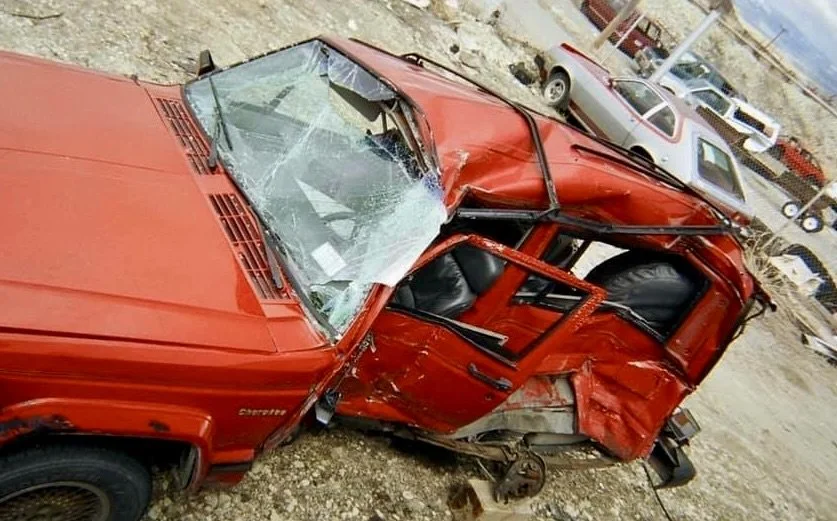
It was just another day at the office — attempting to find a woman's pulse as she sat lifeless in the front seat of her car, a red Jeep Cherokee, her head slumped forward, her face covered in blood, shattered glass everywhere, the car resembling something that had had a fight with a wrecking ball. It was around 10pm, the middle of winter, and snowing. I was unable to find a pulse, and her breathing was sporadic. As I shone my torch on her face, she was pale. The picture was grim. We were somewhere in Montana, on the I-90, quite a distance from the nearest town, with a group of irate bystanders hurling insults and advice to leave her alone, claiming that an ambulance was en route.
At that point, feeling a little overwhelmed, I had one question. Where the fuck was Tim?
Rewind twenty minutes or so. Tim and I had come across what appeared to be a car accident as we approached on the opposite side of the road. We were making our way home to Vancouver after a great day's skiing at Jackson Hole in Wyoming — the final leg of a one-month skiing road trip across the USA, during which we'd covered the classics: Vegas, the Grand Canyon, all-you-can-eat buffets, and of course, the first ever Colonel Sanders Kentucky Fried Chicken restaurant.
As we approached the scene on a highway covered in a blanket of snow in the dark of night, Tim and I — both working in a large trauma hospital in Vancouver at the time — found ourselves debating whether to stop or not. When I say debate, given it involved yelling and arguing, it was more of a verbal boxing match.
I eventually won. We agreed to stop. With Tim at the wheel, he started to apply the brakes. Next thing we knew, the van started to slide on the icy road. Tim started yelling again. "Where do I stop?" I yelled back, "I don't fucking care, just stop!" Before we knew it, we were slipping and sliding past the scene at speed, which by this point, despite the lack of light, had all the features of an accident — several cars pulled over, people standing around.
By the time we stopped, we were some distance down the road. I donned a jacket, grabbed a torch, and made my way back up to the accident scene — or as it turned out, a bystanders' convention.
Initially, it was difficult to piece together the puzzle. It was dark. A white van sat stopped in the middle of the two-lane eastbound highway with damage to the front end. Other cars were parked on the side of the road. There was a wide stretch of snow-covered grass, about twenty metres wide, between the east and westbound lanes, where a group of people stood in a circle talking amongst themselves. Meanwhile, eastbound traffic continued to make its way through the scene, at times coming dangerously close to adding more chaos to the situation.
I made my way to the group and asked what I thought was a straightforward question: "Does anyone need any help?" Someone responded, "It's okay, an ambulance is on the way." I found that an odd response. "What for?" I asked. The same man pointed towards a vehicle about twenty metres away, sitting on the centre strip, with no one near it. In the front seat, alone, a body sat motionless.
As I moved toward the car, I could see the entire left side was smashed in — what we referred to in the business as being T-boned. The nature of an impact where one vehicle slams into the side of another.
Was she dead? That was my first thought.
Fortunately, this was in the days when there were only two options: male or female. Her head was slumped forward, a little to the left, as she sat in the driver's seat. The car door was buckled from the impact. As I attempted to open it, the same people I'd spoken to followed — not to assist, but to heckle. "Leave her alone," they said. "There's an ambulance coming."
I had no doubt there was an ambulance coming. I just wasn't sure when. And that matters. I could see no lights from a nearby town. I continued, ignoring the peanut gallery. The more I ignored them, the louder and more forceful they became. Here I was trying to gain access to assess her, while the crowd threw insults my way as though I were a bad comedian on stage at a pub with a drunken audience. It was impossible to concentrate.
At that point, I stopped, turned to the peanut gallery, and calmly asked a question.
"Does anyone else have a background in first aid or healthcare?"
A question that appeared quite innocent but was in fact a sneaky interview assessing for credibility.
Their response? A combination of mumbling and the sound of crickets.
My response? A cross between a crazed maniac and someone stepping on a landmine.
At the top of my voice, I yelled, "Well, shut the fuck up, because I'm trying to concentrate — unless you can help, walk the fuck away."
I turned around and returned my focus to the driver. I could not find a pulse, nor sense she was breathing. Her head was slumped further forward than I'd ever seen. I couldn't help but think: broken neck?
At that point, a woman appeared from behind and hesitantly asked, "Is there something I can do to help?" I asked her to find a first aid kit — ideally some gloves, given the presence of blood. A lot of blood. She soon returned with one glove and a beach towel.
A beach towel and one glove. Perfect.
I created a makeshift hard collar for her neck. As for the glove — now I could put one hand in places you shouldn't touch without one. Or consent, for that matter. I was desperate to find a pulse. I was also desperate to find Tim.
Given the sporadic and shallow breathing, this was not a good picture. I wanted to get her out of the car.
Where the fuck was Tim?
Like a poorly timed game of Where's Wally, Tim was still in our van a few hundred metres down the road, eating crackers and dip. None the wiser, blissfully unaware of what was playing out. Fortunately, he eventually became bored — maybe a little curious — and made his way through the dark toward the roadside circus. He'd missed the best act. Me, losing my shit. Thank God he missed it, because he would never have let me live it down. Just as I don't let him live it down that he was eating crackers and dip — twenty years on.
As he walked in, belly filled with crackers and dip, I gave him the picture. "Can't find a pulse, her breathing's ineffective, she's cyanotic. Suspecting internal bleeding, maybe a spinal fracture. We need to pull her out."
Tim and I worked in the same emergency department at Vancouver General Hospital, so we knew what to do. Sort of. The heckling, the single glove, and the beach towel as medical supplies were new. But everything else was the same. Sort of. We improvised.
Like a deer in headlights, Tim stood bewildered, still getting his head around the scene. Before long, we started to remove her from the front seat — but there was a catch. The seatbelt was stuck. Fortunately, I hadn't offended everyone — a truck driver came to the rescue with a knife. We cut the seatbelt and lifted her out using the top-and-tail technique: me giving her a hug from behind, Tim lifting her legs. We transferred her to the snow-covered ground. Not ideal, but it was all we had.
The next glitch: her leg remained stuck under the crushed dashboard. Let's just say this particular top-and-tail move is not something you learn in yoga class — nor should you.
While all this was going on, apparently an ambulance was en route.
Years later, as I reflected on that night, I realised that truck driver had played a significant role.
Now on the ground, covered in glass, neither Tim nor I could find a pulse. We were close to starting CPR. Then, finally, a sign. She became agitated. A groaning sound. Her arms began to move. Not much — but enough to confirm we had life. We found a pulse in her groin, the femoral artery. The place you find one when it's gone from the wrist. More effective breathing followed. Laying her flat and keeping her head straight gave us the edge we needed.
We were left with more questions than answers. Internal bleeding? Collapsed lung? Spinal injury? Head injury?
Where the fuck was the ambulance?
But thank God Tim was by my side. To share the load. To share the brunt of the hecklers.
We needed one thing: a big fancy hospital with fancy machines. It reminded me of a classic line from Monty Python — "I need the machine that goes bing!" All we had was one glove, a beach towel, and a woman on a bed of snow.
The police arrived. He had a first aid kit. I can't recall exactly what he was doing with it, but it involved something along the lines of putting a Band-Aid on her foot. As I've always said — a first aid kit does not save a life. Controversial, I know.
Around this same time, a loud voice called out: "LOOK OUT, LOOK OUT!"
I was distracted, with my hand in the woman's groin. Sounds wrong, I know — I was monitoring her heart rate. The next thing I heard was a roaring sound, a strong wind tearing through. Then, out the corner of my eye, a glimpse of something passing at high speed.
I looked up. There was no one around. No police. No Tim. No bystanders. No Wally. Just me, wearing one latex glove, and a woman I'd never met, with my hand in her groin.
The loud voice hadn't been another irate bystander — it had been a warning. A truck was out of control as it approached the scene, jack-knifing as it travelled eastbound, its long trailer swinging at right angles across the road. Fortunately, the driver backed off the brakes, the trailer straightened, and it passed through the scene with seconds to spare — missing the woman and me by a few metres.
Everyone else had run for cover.
Nowhere to be seen — along with the ambulance.
This game of Where's Wally was wearing thin.
Eventually, people made their way back. I directed the police officer to do his actual job: go up the road and manage the traffic to prevent another accident, instead of playing with a first aid kit to give the appearance of saving a life.
Finally, the ambulance arrived.
Tim also reappeared. Thank God.
In hindsight, Tim was smart. I would have run too. No one wins a fight with a truck.
By that stage, I was ready to hand over the baton. In my case, one blood-stained glove.
The ambulance officer walked over, dressed in a clearly identifiable uniform. Without delay, I gave a handover. "Upon my arrival, she was unconscious in the driver's seat, head slumped forward, unable to locate a pulse, irregular and ineffective breathing, hypoxic. Given she was haemodynamically unstable, we removed her from the vehicle and placed her supine to commence CPR if needed. Assuming a possible spinal injury, I created a makeshift collar. Once flat, we palpated a femoral pulse and her breathing became slow and regular. I suspect internal bleeding, spinal and head injury given the mechanism of injury, and hypoxic brain injury given the absence of breathing on my arrival."
It's probably fair to say I delivered all of that without a pause, without punctuation, without taking a breath.
The paramedic stood there staring at me. Saying nothing. The same look Tim gave when he first turned up. Come to think of it, the same look some maximum-security prisoners gave me years earlier during a workshop on empathy. Deer in headlights.
I turned to the paramedic and said, "As I said, she's hypoxic. Do you have oxygen?" That got a reaction — she walked off and returned with an oxygen bottle and mask. "As I mentioned, that's a beach towel around her neck — do you have a hard collar?" We swapped it out. "As I mentioned, I suspect a spinal injury and she's lying on snow — do you have a spine board and stretcher?"
We continued this routine until the woman was in the back of the ambulance. All along, the paramedics looked to me for direction while I kept wanting them to take the lead. With the ambulance doors closed, Tim and I looked at each other and simultaneously thought: holy shit.
Tim suggested we head back to the van.
For crackers and dip, I assume.
But one thing wasn't sitting right. The ambulance was still there. The one thing I'd been waiting for — I now wanted gone. A second ambulance had arrived. Two more paramedics stood around. I approached and asked, in what I can only assume was a confused and impatient manner, "Why is that ambulance still here?"
"Why do you ask?"
"Because that woman needed to be in hospital yesterday."
The paramedic responded in a nonchalant manner, suggesting I go tell them to get a move on.
I opened the back doors. The paramedic inside was casually organising equipment as though preparing for morning tea, with the unconscious woman as the main guest. The type of person who prioritises cleaning the kitchen after dinner over spending time with the people still at the table.
"What are you doing? Get going — she has internal bleeding, she needs to be in hospital now."
They listened. They drove off into the dark.
As Tim and I returned to the van and continued west, I regretted not going with them. Back then, there was much debate about whether paramedics should spend less time treating patients at the scene and instead load them fast and drive hard to get them to hospital. The golden hour — the idea that the faster a patient reaches a big fancy hospital, the better the outcome. With the machines that go bing.
That regret deepened over the following days. I came to learn it wasn't quite an ambulance that had arrived. It was, in fact, Wally dressed as a paramedic. Well-meaning — they were volunteers. Which explained why they'd been looking to me for direction. I only wish they'd told me.
It reminded me of the time a drag performer at a show I'd been dragged to approached me with a drink, said my name as though we knew each other, and tried to hit on me. My face apparently said it all. I later learned it was a guy from medical records at the hospital where I worked. If only he'd told me. I wouldn't have given him that look.
Tim and I continued driving for some time that night. You tend not to be sleepy after such an event. Quite the opposite. We debriefed as we drove. I wondered where the single glove came from. Lucky the truck driver had a knife. My disbelief that Tim had initially remained back in the van, to eat a sandwich, or so I thought — he made it clear, it was crackers and dip.
As for the woman in the driver's seat, we didn't have high hopes.
Sorry — you'll need to buy the book when it arrives to find out how this story plays out.
Written by; Jeremy Limpens