An excerpt from A Tale Told by an Idiot — full of sound and fury, signifying nothing. A tragicomical memoir in progress.
Chapter 5 – Just deserts
It was just another day at the office. You know the type: in a 360-degree spin while sitting in the back of an ambulance, a patient on the stretcher, and the ambulance officer driving while calling out, ‘Holy shit, hang on!’
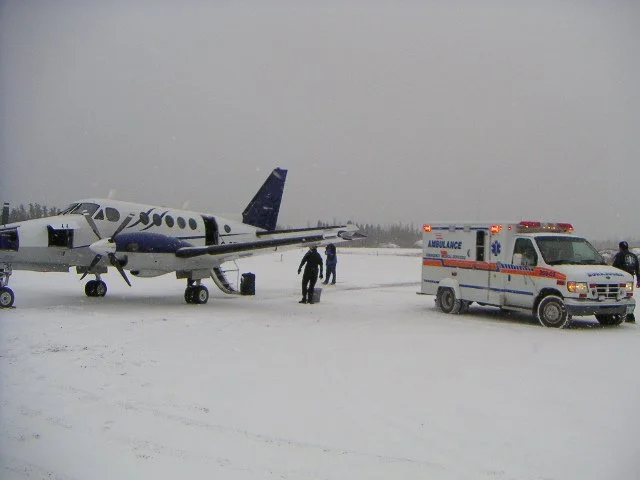
At the time, we were en route to a hospital in Winnipeg, Canada, not going overly fast, as the roads were covered in a blanket of snow and ice from a snowstorm so severe that the city and surrounding suburbs were closed to all traffic except emergency services.
We had initially flown in via air ambulance from a community up north, about one hour’s flight, transporting a patient who’d had a run-in with a guy and a kitchen knife. The guy who owned the knife headed off with the police. The knife remained in the patient’s leg, and he came with me. Pulling it out runs the risk of making the bleeding worse. Same theory as the Dutch boy who spots a leak in the dyke and plugs it with his finger all night until help arrives, saving his town from the flood. In this case, the knife plugs the bleeding, saving the aircraft floor from the blood.
As for the 360-degree spin, it was a surreal experience, watching out the window as we slid sideways, in slow motion, towards a power pole. Fortunately, the snowbank saved the pole, or us, depending on which way you look at things. Good news either way, the knife remained in place.
We eventually made it to the hospital, where I handed over the knife attached to the patient to the emergency department staff. We then returned to the airport and took off into the dark, the wind and the heavy snow. An hour later, we landed on a snow-covered runway in Cross Lake, a small community in northern Manitoba. It was the depths of winter, around minus 20°C on a good day, with snow and ice stretching as far as the eye could see.
As we pushed the aircraft into the hangar with the same truck we used to drive to and from the airport, my satellite phone rang. It was dispatch with another job. It was nearing midnight, and we had been going for close to ten hours. The pilots were exhausted. I, however, had managed a nap on the empty patient stretcher during our return. Napping happens to be a well-honed skill of mine. Even so, I was running on fumes myself. The pilots’ fatigue had been evident on approach, their voices over the radio slurred like two drunks at a pub on a Friday night. We weren’t fit to fly, but technically, on paper, the pilots had around three hours of duty time left. Enough to fly north, collect the patient, land midway south to refuel and push on to Winnipeg, but not enough to get us home. It all worked perfectly, provided nothing went wrong.
To make matters more interesting, the patient was experiencing a first psychotic episode, in a community even further north. Normally, this wouldn’t be an issue, but that fuel stop meant landing midway with the patient on board, in a snowstorm that showed no sign of letting up.
After speaking with the community nurse about the patient’s condition, I concluded it was best to wait until daylight. I’d had plenty of experience with psychotic patients in emergency departments and community settings, situations where it sometimes took multiple police and hefty security guards to wrestle them down long enough for sedation. So, with that mental image, and a strong desire to avoid an in-flight sequel of Snakes on a Plane, but with a raging psychotic instead of snakes, delaying the medical evacuation seemed like an easy call. It wasn’t a no. It was a not like this. In daylight, I could source a second clinician and we could consider sedation for the trip. The nurse agreed and was happy to hold on to the patient overnight. Clinically, and for everyone’s safety, it was the right thing to do. I called dispatch with my decision.
Minutes later, my phone rang again. It was the dispatch manager, and she was furious. “How dare you reject a medical evacuation?” she snapped. I explained I wasn’t rejecting it, just delaying it until it could be done safely. She ordered me to proceed. I stood my ground. The call escalated into a shouting match. Finally, she pulled the threat card, warning that I would be reported to the company directors of Skyward Aviation. I made my position clear: we would complete the retrieval in the morning, and we would do it properly.
To a private aviation company, the patient wasn’t always the priority. Being able to send the government a $20,000 invoice was. I’d also come to realise that the pilots were often too afraid to speak up. They’d worked hard for their poorly paid jobs with this regional airline, which also ran dedicated air-ambulance aircraft, and speaking up could jeopardise their careers now and well into the future.
The next morning, after a well-earned sleep, I called dispatch. They told me we were no longer needed. I was relieved, given the stormy conditions hadn’t improved. However, I was a little curious as to why the change. It wasn’t until a month later that I found out they had dispatched a different crew that same night. This crew included a flight nurse who had limited experience with psychotic patients. A midwife, to be exact.
They ventured off into the dark, heading into a storm of their own. The aircraft was a Cessna Conquest, fast but noisy, usually seating up to 10 passengers. But as an air ambulance, the seats were removed, and a stretcher placed down one side of the cabin, with a bench for the crew opposite. Above the patient stretcher was medical equipment for monitoring the patient mid-flight.
Shortly after departing from the remote community, the patient became increasingly agitated. As the aircraft reached a cruising altitude of about 25,000 feet, the patient unbuckled, jumped off the stretcher, and tried to open the rear door of the aircraft, presumably seeking an escape, without a parachute. Unlikely to go well.
Chaos quickly ensued in the back of the plane.
The midwife tried to calm the patient, but as anyone in the field will tell you, talking to someone in a psychotic state using logic rarely leads to a good outcome. In fact, it tends to fuel the fire. The midwife and the patient soon found themselves in a mid-flight wrestling match. The problem was that when psychotic people get worked up, they have the strength of a grizzly bear, without the sense of pain or fear. Personally, I wouldn’t recommend letting a grizzly board a private flight to the city.
To make matters worse, the midwife’s frantic screams for help went unnoticed by the pilots in the cockpit, only a few metres away, drowned out by the deafening sound of the aircraft’s twin-turbine engines. Meanwhile, the equipment above the stretcher proved perfect for a patient with an innate talent for throwing things and causing chaos. Medical equipment, in the wrong hands, can also double as weapons.
Eventually, the midwife managed to throw her shoe, of all things, into the cockpit, hitting the pilot in the head. That finally grabbed their attention. While the captain continued flying, diverting to a closer airport, the co-pilot joined in the wrestling match.
In poor visibility and with the storm still raging, the captain landed at Thompson airport, about halfway to Winnipeg, where the fuel stop would have been had our crew done the transfer. They made the stop after all, just not the way anyone had planned. Police were waiting on the tarmac. As the aircraft came to a stop and the door opened, the police restrained the patient, sort of, but not without injury. The police officer ended up with a broken arm, and the midwife and co-pilot were left bruised, battered and shell shocked. It didn’t stop there. Once at the hospital’s emergency department, the patient ripped the door off its hinges.
When I later heard the details of the case, I was shocked and dismayed for the crew, and angry at the dispatch manager and the company. All that, for a $20,000 invoice. As for the midwife, back then, psychologically safe workplaces had not been invented yet. Certainly not out there.
I never did hear how either patient got on. That was often the nature of this line of work. Fly in, fly out. As for the kitchen knife, I did wonder if it was returned to its rightful owner.
Sorry — you'll need to buy the book when it arrives to find out how this story plays out.
Written by: Jeremy Limpens